

Walking Into Belonging: Community In Mérida

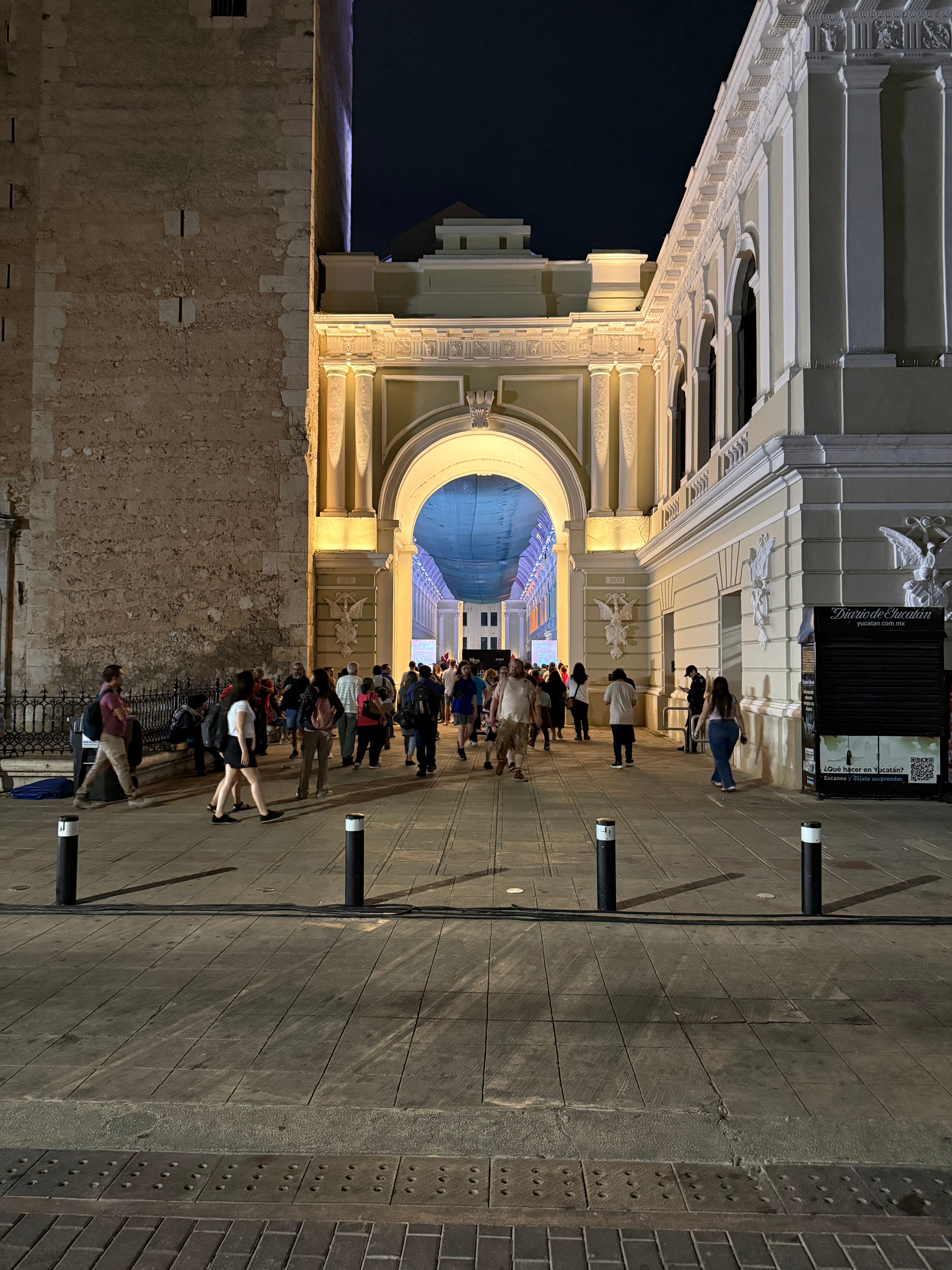
There is a small, almost imperceptible ritual that happens every time I step outside in Mérida.
If I make eye contact with someone, anyone, we greet each other. A nod. A “buenos días.” A smile that lingers just long enough to register. It does not matter if we have never met. The exchange is brief, but it is grounding. It reminds me that I am not moving through anonymous space. I am moving through a shared one.
That feeling deepens at night, especially now. The evenings have cooled, and the city seems to exhale. People come out.
Right now, Mérida Fest is underway. It is a two-week celebration that turns the historic center into a living, breathing stage. It is also the city’s birthday celebration. This year marks 484 years since Mérida’s founding.
For fourteen days, every night brings something different. Concerts. Theater. Exhibitions. Light installations. And perhaps most importantly, it is all free. Anyone can attend. You do not need a ticket, perfect Spanish, or even a plan. You simply show up.
A few nights ago, I wandered downtown without intention and stumbled into Solo la Luz, where local light artists transformed streets, facades, and plazas into quiet, luminous works of art. The square was full, not crowded in the anxious sense, but alive. Families with children. Couples. Older people walking slowly arm in arm. Teenagers sitting on steps.
A large concert played on one end of the plaza. A theatrical performance unfolded on the other. Individual musicians were scattered throughout the streets, filling the air with sound. No one was rushing. No one seemed out of place.
People were happy.
What struck me most was not the scale of the event, but how accessible it felt. There were no barriers to participation and no sense that this was meant for a specific type of person. It belonged to everyone.
That openness has shaped my experience here in quieter ways too. I am not fluent in Spanish, not yet, but I have never felt like an outsider. I do not feel pressure to perform belonging or prove myself. I feel welcomed to attend and participate at my own comfort level. That kind of inclusion, unforced and unspoken, is something I have rarely experienced before. Once you feel it, you realize how unusual it is.
This spirit is not limited to festivals. In Mérida, and in many cities across Mexico, it is common to shut down major streets on certain days so people can reclaim them. Families walk together. Children ride bikes and scooters. People skate, push strollers, talk, laugh, linger. For a few hours, the city prioritizes presence over productivity, and people over traffic.
Living here, I do not have a car. And because of that, or maybe because the city invites movement, I walk almost everywhere. Most days I walk between four and eight miles, roughly six and a half to thirteen kilometers.
Mérida is deeply walkable, and at least for now, the distance disappears because I am absorbed by my surroundings. A street I have not explored yet. A corner I have not turned. Curiosity pulls me forward.
I often check my phone to make sure I do not overdo it. But the truth is, walking here has become meditative. Six weeks in, my body is already changing. My clothes fit a little looser, in a good way. I feel more toned and more awake in my body. Movement feels less like something I schedule and more like something that naturally happens as part of living.
There is growing evidence that environments like this, walkable, socially connected, and oriented around public life, have measurable health benefits. Strong social ties are linked to lower rates of depression and anxiety, reduced cardiovascular risk, better immune function, and longer life expectancy. Loneliness, by contrast, is now considered a serious public health risk.
What is often overlooked is how much community is shaped by design and culture. Walkable streets. Public plazas. Events that do not require spending money to belong. Norms that encourage acknowledgment rather than avoidance. These things make connection easier and isolation harder.
In many places, community has become something we are expected to manufacture privately. Dinner plans booked weeks out. Friendships squeezed between obligations. Social connection treated as optional. Here, it feels woven into daily life. You do not have to chase it. You just have to step outside.
I have written about community before, but this feels different. Less aspirational and more embodied. It is not about creating something new, but about remembering something old. The simple human need to be seen, to move, to gather, and to linger without justification.
Walking home that night, light installations fading behind me, I thought about how much of modern life trains us to move quickly, eyes forward, detached.
Mérida gently insists on the opposite.
Slow down.
Look up.
You are welcome here, even if only for a moment.
In a moment when many places feel tense, being here has reminded me that community doesn’t have to start big. Sometimes it begins with music played outside, art made in public, a shared meal, a bonfire, or an open door. Small gestures, repeated, can slowly change how a place feels. I’m curious what small acts of togetherness feel possible where you live.
Beautiful people and beautiful city.